
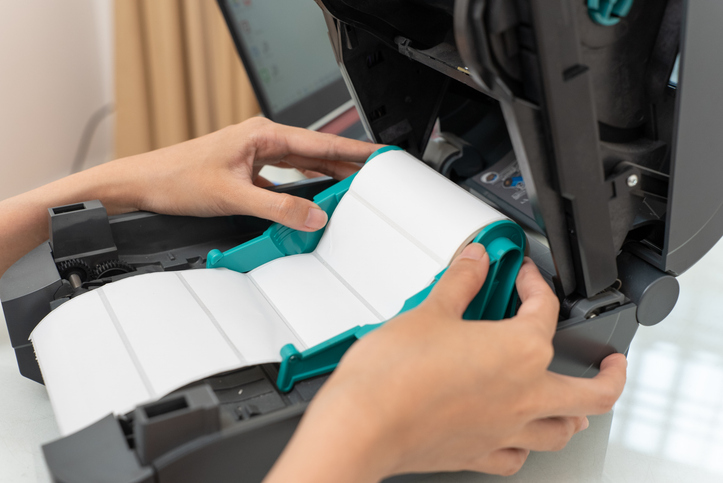
A copier handles a lot, but some jobs call for a different tool. Here’s where specialty and label printing come in, and why the right device makes all the difference.
The copier in your office is a workhorse. It prints, copies, scans, and faxes, and for the vast majority of what a business puts on paper, it’s exactly the right tool for the job.
But not every printing job is a letter, a report, or a contract. Somewhere in your operation, there’s probably a task the copier was never built to handle. A shipping label that needs to survive a cross-country trip. A wristband that has to stay legible on a patient all day. A barcode that a scanner must read correctly every single time, or the whole line backs up.
That’s the world of label and specialty printing, and it’s easy to overlook until you need it. When you do, using the wrong device, or forcing a general-purpose machine to do a job it wasn’t designed for, tends to create more problems than it solves. Here’s a look at where specialty printing shows up, and why matching the device to the work matters more than most people expect.
Why a Copier Isn’t Always the Answer
It’s a fair question: if the office copier already prints, why can’t it print labels too?
The short answer is that labels and specialty media are a different kind of job. A standard copier is designed for standard paper at office volumes. Label and specialty work often calls for different materials, adhesives, and durability, plus features a copier simply doesn’t have. Consider what these jobs actually demand:
- A product label may need to survive heat, cold, moisture, or handling. Office paper and toner aren’t built for that.
- Special media. Labels, wristbands, and tags come on rolls, in specific sizes, and on materials a copier’s paper path can’t accommodate.
- Precision and consistency. A barcode that scans reliably every time requires print quality and registration that’s purpose-built, not approximated.
- Volume in bursts. Some operations need hundreds of labels on demand, printed quickly and reliably, without tying up the office copier everyone else is waiting on.
None of this means the copier is falling short. It means the job belongs to a different tool, the same way you wouldn’t use a delivery van to haul gravel.
Labels on the Manufacturing Floor
For manufacturers, labeling isn’t a side task. It’s woven into how product moves.
Think about everything that needs a label in a production and distribution environment: raw materials coming in, work-in-progress moving between stations, finished goods heading out, and shipping labels that carry the order to its destination. Each one has to be accurate, scannable, and durable enough to survive the conditions it’ll face.
When labeling works, it’s invisible. When it doesn’t, the costs pile up fast: a mislabeled shipment, a barcode that won’t scan at the dock, a product that can’t be traced back through the line. Specialty label printers are built for exactly this: high-volume, durable, precise labeling that holds up in an environment where a smudged or unreadable label isn’t a minor annoyance, it’s a bottleneck.
Labels in Healthcare
Manufacturing may be the first place people picture labels, but healthcare relies on them just as heavily, and often with even higher stakes.
Walk through a typical day at a practice or facility and the specialty printing is everywhere. Patient registration produces wristbands that must stay legible and scannable throughout a stay. The pharmacy prints prescription labels where accuracy is not negotiable. Specimens, samples, and records all need clear, reliable labeling to keep the right information attached to the right person.
In this setting, a label that fades, smudges, or won’t scan isn’t just inconvenient. It’s a patient-safety and accuracy issue. That’s why healthcare organizations lean on purpose-built label printers rather than improvising with general office equipment. The right device produces labels that are clear, consistent, and built to hold up to the day.
Matching the Device to the Work
Here’s the thread running through all of this: specialty printing is a matching problem. The goal isn’t the fanciest machine or the biggest one. It’s the device that fits the specific job.
A high-volume shipping operation, a pharmacy, and a manufacturing line all have different needs in terms of label size, material, durability, print speed, and how the device connects to the software already running the operation. Get that match right, and the equipment quietly does its job for years. Get it wrong, and you’ve bought a machine that’s constantly fighting the task in front of it.
Figuring out that match is where a lot of businesses get stuck, and it’s where the kind of dealer you work with starts to matter.
Where an Independent Dealer Comes In
This is one of those moments when being an independent dealer genuinely changes the outcome.
A provider that’s locked into a single manufacturer can only offer that manufacturer’s answer to a label problem, whether or not it’s the best fit for your line, your pharmacy, or your dock. Because we’re independent, we’re free to look at the actual job and recommend the specialty device that fits it, drawing on more options than a single-brand competitor can put on the table.
And specialty printing is exactly the kind of area where that range matters, since the right solution for a manufacturing floor and the right solution for a patient-registration desk usually aren’t the same device at all.
The One-Stop-Shop Advantage
There’s a practical bonus to sorting this out with a partner you already work with. Specialty and label printing doesn’t have to mean adding another vendor to your list.
The same local team that handles your copiers and managed print can help you get label and specialty printing right, from recommending the device to keeping it supported and supplied. That means one relationship instead of several, and one number to call when you need help, backed by our four-hour average response time for service calls.
We work with businesses across Maine, New Hampshire, and Massachusetts, and we’ve seen how much smoother operations run when the labeling just works, on the floor, at the counter, and everywhere in between.
If there’s a printing job in your operation that your copier has been struggling to handle, there’s a good chance the right specialty solution exists for it. Our local team is happy to help you find the tool that actually fits the work.